

EU Battery Regulation: TWS Technology Attains TÜV Rheinland Conformity
News originally published by
EIN Presswire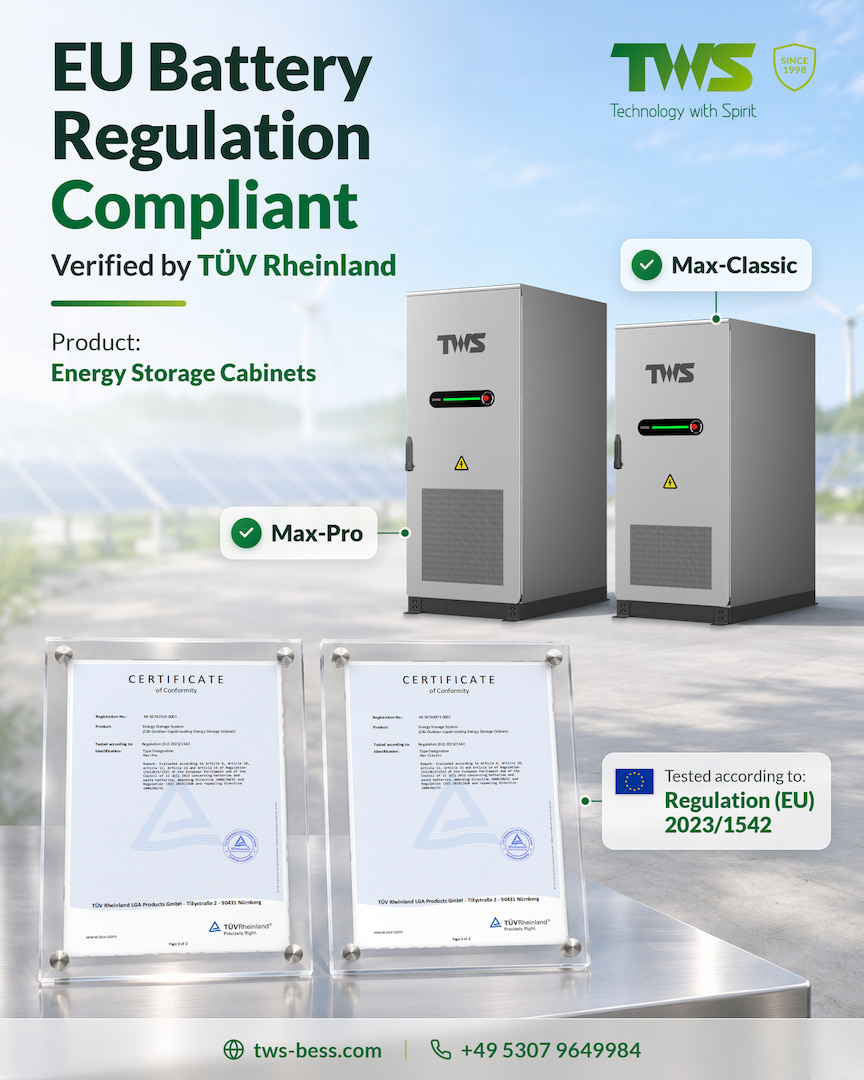
TWS Technology's Max-Pro and Max-Classic energy storage cabinets alongside their official TÜV Rheinland certificates of conformity under Regulation (EU) 2023/1542.

EU Battery Regulation TÜV Rheinland Conformity Certificate Award Ceremony for TWS Technology

TWS ESS's Warehouse in Frankfurt, Germany
This achievement marks TWS Technology's formal entry into full compliance under the European Union's latest framework, placing the company among the very first energy storage manufacturers in China to secure independent third-party verification. Currently, two of the company's flagship commercial and industrial (C&I) storage systems—the Max Classic and the Max-Pro—have successfully passed conformity certification under the regulation.
What Is the EU Battery Passport?
Starting February 18, 2027, every industrial battery over 2 kWh sold in Europe must carry a digital battery passport accessible via an on-product QR code [1, 2].
The passport requires independent, verified proof across four core pillars:
Full Lifecycle Carbon Footprint:
Audited carbon accounting spanning raw material extraction, cell manufacturing, and assembly [3].
Critical Raw Material Due Diligence:
Official audits of cobalt, natural graphite, lithium, and nickel supply chains, scrutinizing environmental impacts alongside international labor standards, workplace health and safety, and human rights protections [4].
Recycled Material Targets:
Mandatory declarations and recovery targets for secondary raw materials [5].
Disassembly, Repairability & Recycling:
Design requirements enabling module-level disassembly, repair, and end-of-life battery recycling efficiency [6].
Why This Matters: Substantial Risks for Importers, Distributors, and EPCs
A common industry misconception is that the new regulation strictly impacts manufacturers. In practice, regulatory liability extends across the entire downstream supply chain:
The Rebranding Risk (Article 44):
If an importer or distributor sells an energy storage system under their own company name or logo, or modifies it, EU law legally reclassifies them as the manufacturer [7]. This automatically transfers full civil liabilities, technical dossier maintenance, and compliance obligations onto the distributor [7, 8].
10-Year Record Keeping (Article 46):
Every distributor, importer, and logistics partner is legally required to maintain complete commercial transaction records of suppliers and buyers (including exact model numbers and serial numbers) for a full decade [9].
Customs Blocks & Returns:
Under Regulation (EU) 2019/1020, customs authorities will suspend release for shipments lacking complete conformity documentation [10]. Non-compliant batteries face formal refusal of entry [11] and must be re-exported outside the EU or destroyed under customs supervision at the economic operator's expense [12].
Heavy Fines & Project Delays:
Customs holds disrupt deployment schedules, triggering damages for EPC contractors. Furthermore, national statutes like Germany's Batterierecht-Durchführungsgesetz (BattDG) impose fines up to €100,000 for placing non-compliant batteries on the market [13] and up to €500,000 for serious due diligence breaches [13].
By securing accredited TÜV Rheinland conformity ahead of statutory deadlines, TWS Technology significantly reduces these commercial and regulatory liabilities for project partners.
Local European Support: Fast, Safe, and Reliable
Regulatory compliance is the foundation; operational reliability requires rapid on-the-ground execution:
Warehouse in Frankfurt: TWS Technology maintains local safety stock of replacement components and battery modules in Germany to eliminate long logistics lead times.
Local EU Engineering Team: European field engineers provide on-site commissioning, maintenance, and technical diagnostics to reduce time-zone friction.
High Safety Standards: TWS Technology energy storage systems are engineered for round-the-clock reliability and power continuity across mission-critical facilities, metallurgy, and industrial plants.
Navigating EU Battery Compliance for Upcoming BESS Projects
With enforcement deadlines approaching, project stakeholders frequently evaluate key regulatory questions, including:
How the legislation affects EU-based manufacturers.
Whether specific battery categories remain exempt from the new rules.
Organizations planning energy storage deployments in Europe can consult the TWS Technology technical and compliance team to establish a clear regulatory roadmap.
Contact: infoess@tws.com
Website: https://tws-bess.com/
References
[1] Regulation (EU) 2023/1542 of the European Parliament and of the Council (July 12, 2023)
Official Journal of the European Union, OJ L 191, 28.7.2023, pp. 1–117. Concerning batteries and waste batteries. Entered into force August 17, 2023.
Official Legal Text: https://eur-lex.europa.eu/eli/reg/2023/1542/oj
[2] Regulation (EU) 2023/1542, Chapter IX, Article 77 (Battery Passport)
Article 77(1): 'From 18 February 2027, each LMT battery, each industrial battery with a capacity greater than 2 kWh and each electric vehicle battery placed on the market or put into service shall have an electronic record ("battery passport").'
[3] Regulation (EU) 2023/1542, Chapter II, Article 7 (Carbon footprint of batteries)
Article 7(1): Mandatory life cycle carbon footprint declaration and third-party verification across production stages.
[4] Regulation (EU) 2023/1542, Chapter VII, Articles 47–53 & Annex X (Due Diligence & Social/Labor Rights)
Articles 48–51 and Annex X point 2 explicitly include international labor standards, workplace health & safety, human rights, and child labor prohibitions alongside environmental due diligence.
[5] Regulation (EU) 2023/1542, Chapter II, Article 8 (Recycled Content)
Article 8(1): Documentation and percentage thresholds of cobalt, lead, lithium, and nickel recovered from waste present in industrial and EV batteries.
[6] Regulation (EU) 2023/1542, Chapter II, Article 11 & Chapter VIII, Articles 70–71
Article 11: Removability and replaceability of batteries. Articles 70–71 & Annex XII: Treatment, recycling efficiencies (by chemistry), and levels of recovery of materials.
[7] Regulation (EU) 2023/1542, Chapter VI, Article 44 (Obligations of manufacturers apply to importers and distributors)
Article 44 establishes that an importer or distributor is considered a manufacturer when marketing under their own brand/trademark, modifying batteries, or altering intended purpose.
[8] Regulation (EU) 2023/1542, Chapter VI, Article 38 (Obligations of manufacturers)
Articles 38(1)–(9): Establishes full manufacturer duties including conformity design, drawing up EU declarations of conformity, compiling technical files, and keeping records for 10 years.
[9] Regulation (EU) 2023/1542, Chapter VI, Article 46 (Identification of economic operators)
Article 46(1) & (2): Mandates that economic operators must be able to identify who supplied them and to whom they supplied batteries (with exact models and quantities) for 10 years after supply.
[10] Regulation (EU) 2019/1020 on Market Surveillance and Compliance of Products, Chapter VII, Article 26
Article 26(1)(a) & (b): Mandatory suspension of release for free circulation by customs authorities where documentation or passport verification is absent or doubtful.
Official Legal Text: https://eur-lex.europa.eu/eli/reg/2019/1020/oj
[11] Regulation (EU) 2019/1020, Chapter VII, Article 28 (Refusal of Release for Free Circulation)
Article 28(1)–(2): Customs and market surveillance authorities formally refuse entry for non-compliant goods.
[12] Regulation (EU) 2019/1020, Article 28(3) & Union Customs Code (Regulation (EU) No 952/2013), Article 198
Mandates that non-cleared, non-compliant goods must be re-exported outside the EU (returned to country of origin) or destroyed under customs supervision at operator expense.
[13] German Battery Implementation Act (Batterierecht-Durchführungsgesetz - BattDG), Part 7, § 60 (Bußgeldvorschriften)
§ 60 Abs. 1 Nr. 1 & Abs. 2 Nr. 23, 29, 30 penalize non-compliant market placement or passport failures with fines up to €100,000. § 60 Abs. 1 Nr. 12(c) & Abs. 2 Nr. 14–18, 20, 22 penalize due diligence violations up to €500,000.
Official BMJ Portal: https://www.gesetze-im-internet.de/battdg/__60.html
Lydia Cui
TWS Technology Limited
+852 9568 3586
Visit us on social media:
LinkedIn
Instagram
Facebook
YouTube
TikTok
Legal Disclaimer:
EIN Presswire provides this news content "as is" without warranty of any kind. We do not accept any responsibility or liability for the accuracy, content, images, videos, licenses, completeness, legality, or reliability of the information contained in this article. If you have any complaints or copyright issues related to this article, kindly contact the author above.
