

The most trusted news from Australia
Provided by AGP
Australia Big Data Security Market 2026-2034 | Size, Share, Outlook
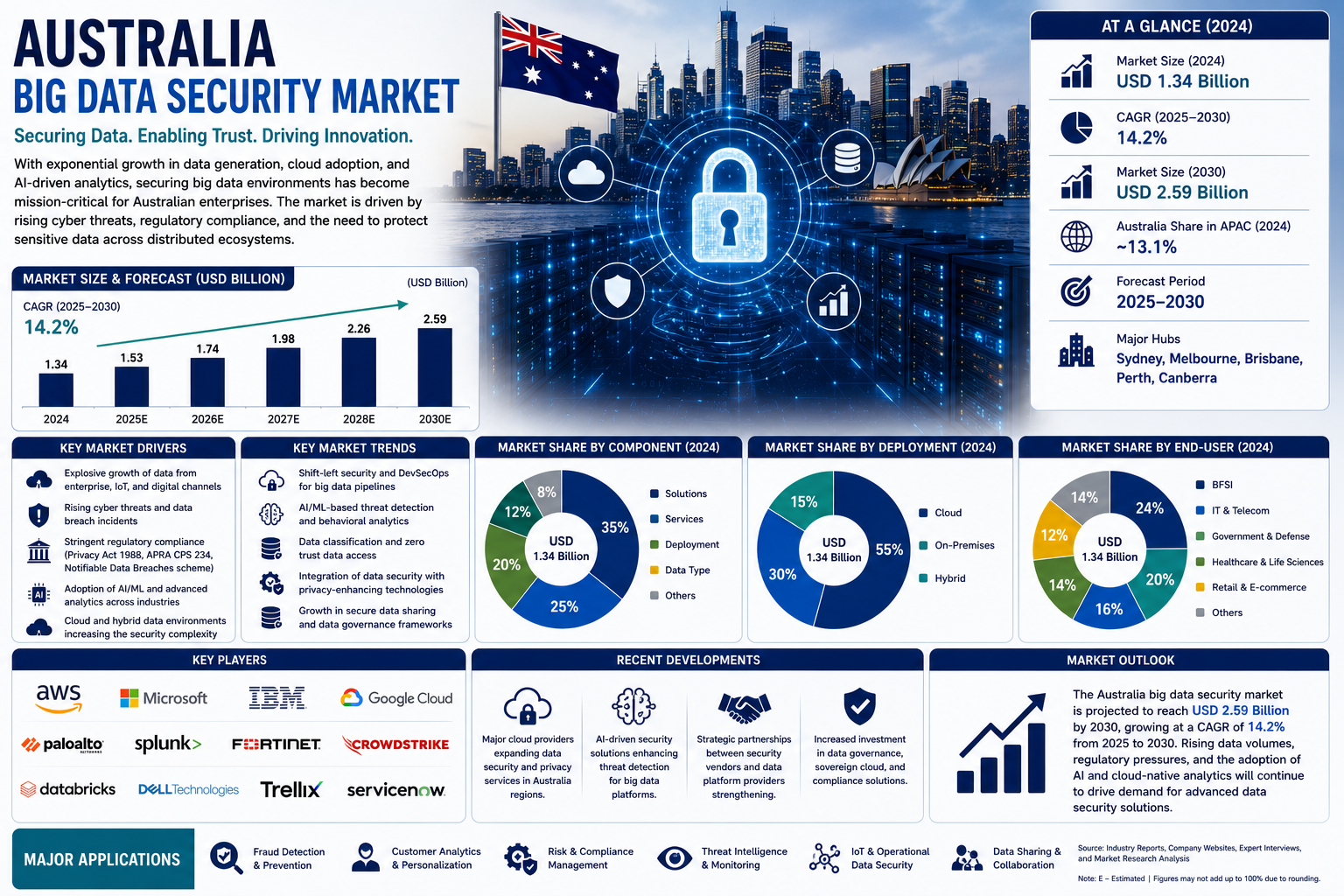
Australia Big Data Security Market
Australia big data security market size reached USD 589.7 Million 2025, is projected to reach USD 1,733.7 Million 2034, a growth rate CAGR of 12.35% 2026-2034.
AUSTRALIA, May 19, 2026 /EINPresswire.com/ --Market Overview
The Australia big data security market size reached USD 589.7 Million in 2025. Looking forward, IMARC Group expects the market to reach USD 1,733.7 Million by 2034, exhibiting a growth rate (CAGR) of 12.35% during 2026-2034. The market is experiencing strong momentum as Australian organisations are prioritising investments in advanced cybersecurity solutions to protect increasingly complex data environments. With the country witnessing a dramatic surge in cyber threats, including a twelvefold increase in data breaches reaching 47 million compromised accounts in a single year, the demand for sophisticated big data security platforms encompassing encryption, identity management, threat analytics, and compliance automation is accelerating across both public and private sectors.
Why is Hot Today:
The Australia big data security market is attracting significant attention as Gartner is forecasting that Australian organisations will spend more than AU$7.5 billion on information security in 2026, representing a 9.5% increase from the previous year. The Australian Government is allocating $89.3 million over four years from 2026-27 to sustain and enhance cyber security initiatives under Horizon 2 of the 2023-2030 Australian Cyber Security Strategy. Services Australia is also receiving $160.4 million over four years for security improvements. Meanwhile, the Privacy and Other Legislation Amendment Act is now in force, introducing maximum penalties of $50 million for serious data breaches, and the Cyber Security Act is mandating security standards for smart devices effective from March 2026.
Market Summary
• The Australia big data security market is witnessing rapid growth as rising cyberattacks, evolving privacy regulations, and widespread cloud adoption are compelling enterprises to invest in comprehensive security platforms that integrate data encryption, tokenisation, masking, and real-time monitoring capabilities to protect sensitive information across distributed environments.
• The shift toward cloud-based platforms and hybrid IT environments is transforming how Australian enterprises are managing and securing data, with organisations increasingly adopting multi-cloud strategies that require zero-trust architectures, secure access service edge (SASE) models, and cloud-native security tools providing real-time visibility and control across public, private, and hybrid deployments.
• Escalating ransomware threats are driving urgent investment in big data security solutions, with Australia recording 57 ransomware attacks in the first half of 2025 alone, representing a doubling from the same period in the previous year, with healthcare, finance, and critical infrastructure sectors experiencing the most severe impacts.
• The Office of the Australian Information Commissioner (OAIC) is receiving over 500 data breach notifications per reporting period, with malicious and criminal attacks accounting for 69% of all reported incidents, underscoring the persistent threat landscape that is pushing organisations to adopt advanced threat detection and incident response capabilities.
• Identity and access management solutions are gaining significant traction across Australian enterprises as organisations are implementing biometric authentication, multi-factor verification, and privileged access management systems to secure sensitive data assets and meet stringent compliance requirements under the revised Privacy Act and SOCI Act frameworks.
• The Australian Government is investing USD 6.4 million to establish a cybersecurity information-sharing network for the healthcare sector through CI-ISAC, enabling real-time cyber threat alerts and ensuring healthcare systems remain operational during cyber incidents, reflecting the growing emphasis on sector-specific security collaboration.
• Security software spending across Australia is forecast to increase 12.3% to more than AU$3.3 billion in 2026, with the rapid adoption of artificial intelligence triggering a substantial spike in cybersecurity resources required to secure AI-driven applications and data pipelines across enterprise environments.
How AI is Reshaping the Australia Big Data Security Market
Artificial intelligence is fundamentally reshaping the Australia big data security market, creating both unprecedented defensive capabilities and entirely new categories of cyber threats. Nearly 51% of Australian organisations are reporting encounters with AI-powered cyber threats in the past year, while AI-powered security systems are detecting threats 60% faster than traditional tools and analysing millions of security events in real time. Gartner is predicting that over 75% of enterprises will be using AI-amplified cybersecurity products for most use cases by 2028, up from less than 25% in 2025, marking a dramatic acceleration in AI-driven security adoption.
• AI-Driven Threat Detection and Response: Machine learning algorithms are enabling security platforms to analyse vast volumes of network traffic, user behaviour patterns, and system logs in real time, identifying anomalous patterns and potential breaches that would be impossible to detect through manual monitoring. Autonomous response systems are containing threats within seconds of detection, dramatically reducing dwell time and minimising the potential damage from security incidents across enterprise environments.
• Predictive Security Analytics: AI-powered analytics platforms are moving beyond reactive monitoring to predictive security models that anticipate attack vectors, identify vulnerable data assets, and recommend proactive remediation measures before breaches occur, enabling Australian enterprises to shift from a defensive posture to a prevention-first security strategy. These platforms are leveraging historical breach data, threat intelligence feeds, and real-time network telemetry to build increasingly accurate risk prediction models.
• AI-Powered Data Classification: Automated data discovery and classification tools powered by AI are scanning petabytes of structured and unstructured data across enterprise environments, identifying sensitive information such as personal records, financial data, and intellectual property, and applying appropriate encryption and access controls automatically to ensure compliance with Australian privacy regulations.
• AI in Identity Security: AI-driven identity and access management systems are using behavioural biometrics, continuous authentication, and adaptive access controls to verify user identities dynamically, detecting compromised credentials and insider threats in real time while reducing friction for legitimate users across distributed enterprise environments.
• Combating AI-Generated Threats: Australian organisations are deploying AI-against-AI defence strategies to counter sophisticated threats including AI-generated phishing campaigns, deepfake impersonation attacks, synthetic identity fraud, and automated malware campaigns, with email systems alone experiencing a 131% surge in malware-laden messages alongside sharp increases in phishing attempts.
Request for a sample report: https://www.imarcgroup.com/australia-big-data-security-market/requestsample
Market Trends and Insights
• The adoption of zero-trust security architectures is accelerating across Australian enterprises as organisations are moving away from traditional perimeter-based security models, implementing continuous verification frameworks that authenticate every user, device, and application attempting to access data resources regardless of their location within or outside the corporate network. The 2023-2030 Australian Cyber Security Strategy is actively promoting zero-trust adoption as part of its Horizon 2 objectives for scaling national cyber maturity.
• Cloud-native security solutions are experiencing surging demand as Australian businesses are migrating critical workloads to multi-cloud environments, driving adoption of data encryption, tokenisation, workload segmentation, and unified security dashboards that provide comprehensive visibility across distributed cloud infrastructure while maintaining compliance with local data sovereignty requirements.
• The convergence of cybersecurity and data governance is emerging as a defining trend, with Australian organisations investing in integrated platforms that combine data auditing, compliance monitoring, and security analytics into unified systems that address both regulatory obligations under the Privacy Act and operational security requirements across complex data environments.
• Managed security services and Security-as-a-Service models are gaining substantial traction among small and medium-sized enterprises that lack in-house cybersecurity expertise, providing access to enterprise-grade threat detection, incident response, and compliance management capabilities through subscription-based delivery models. The continuing cybersecurity talent shortage across Australia is further accelerating this trend, as organisations are turning to managed service providers to bridge critical skills gaps while maintaining robust data protection postures.
• The growing emphasis on supply chain cybersecurity is driving Australian organisations to extend their security perimeter beyond internal systems, with the SOCI Act requiring critical infrastructure operators to assess and manage risks associated with third-party vendors, technology partners, and service providers that handle sensitive data across interconnected digital ecosystems. The proposed SOCI Act amendments are introducing enhanced requirements with particular regard to risks arising from foreign ownership, control, or influence over critical data infrastructure.
• Sector-specific security information-sharing networks are expanding across Australia, with initiatives such as the CI-ISAC healthcare cybersecurity network establishing collaborative frameworks that enable real-time threat intelligence sharing between organisations, government agencies, and industry bodies to strengthen collective cyber resilience.
Market Growth Drivers
Escalating Cyber Threats and Data Breach Incidents: The dramatic escalation in cyberattacks is one of the most powerful growth drivers for the Australia big data security market. The country experienced 47 million data breaches in a single year, a twelvefold increase that equates to nearly one compromised account every second. Ransomware attacks are doubling year over year, with 57 incidents recorded in the first half of 2025 alone. Healthcare, banking, telecommunications, and critical infrastructure sectors are being targeted most aggressively by threat actors seeking financial gain and sensitive personal information. Email-based threats are also surging, with a 131% increase in malware-laden messages alongside sharp rises in email scams and phishing attempts. This persistent and evolving threat environment is compelling organisations across all sectors to invest in advanced threat detection, behavioural analytics, automated incident response, and secure access controls to protect their expanding data assets.
Strengthening Regulatory Frameworks and Compliance Pressures: The Australian regulatory landscape is undergoing significant transformation, creating strong compliance-driven demand for big data security solutions. The Privacy and Other Legislation Amendment Act is introducing maximum penalties of $50 million or 30% of adjusted turnover for serious data breaches, along with civil penalties for serious invasions of privacy in force since June 2025. The Notifiable Data Breaches scheme is requiring organisations to detect, report, and respond to breaches promptly, with the OAIC receiving over 500 notifications per reporting period. The SOCI Act is expanding security obligations across 11 critical infrastructure sectors, while the Cyber Security Act is mandating device security standards. Phase 2 enforcement beginning in January 2026 is bringing a more active regulatory focus, with further Privacy Act reforms expected throughout 2026 that will impose more prescriptive and onerous requirements on organisations handling personal information.
Cloud Migration and Digital Transformation: The rapid shift toward cloud-based platforms and hybrid IT environments is fundamentally expanding the attack surface that Australian organisations must protect. Enterprises are increasingly adopting multi-cloud strategies to enhance scalability and reduce costs, but this introduces new vulnerabilities in data flow, access control, and workload management across distributed architectures. The Australian Government's partnership with Amazon Web Services to establish three secure data centres supporting defence operations and Five Eyes intelligence-sharing is highlighting the strategic importance of cloud security at the national level. Traditional perimeter-based security models are no longer sufficient to protect cloud-native applications and distributed workloads, driving growing investment in zero-trust architectures, SASE frameworks, cloud-native encryption, tokenisation, workload segmentation, and unified monitoring platforms that can manage security and compliance across fragmented infrastructure environments while maintaining data sovereignty requirements.
Market Segmentation
The report has segmented the market into the following categories:
Breakup by Component:
Solution
Data Discovery and Classification
Data Authorization and Access
Data Encryption, Tokenization and Masking
Data Auditing and Monitoring
Data Governance and Compliance
Data Security Analytics
Data Backup and Recovery
Services
Breakup by Technology:
Identity and Access Management
Security Information and Event Management
Intrusion Detection System
Unified Threat Management
Others
Breakup by Deployment Mode:
On-premises
Cloud-based
Breakup by Organization Size:
Small and Medium-sized Enterprises
Large Enterprises
Breakup by End Use Industry:
BFSI
IT and Telecommunication
Healthcare and Pharmaceuticals
Financial and Insurance
Retail Trade
Utilities
Others
Breakup by Region:
Australia Capital Territory & New South Wales
Victoria & Tasmania
Queensland
Northern Territory & Southern Australia
Western Australia
Key Players
The market research report has provided a comprehensive analysis of the competitive landscape in the market. Detailed profiles of all major companies have been provided. Some of the key players operating in the Australia big data security market include IBM Corporation, Microsoft Corporation, Oracle Corporation, Broadcom Inc. (Symantec), Palo Alto Networks Inc., CrowdStrike Holdings Inc., Fortinet Inc., Splunk Inc. (Cisco Systems), Thales Group, and Micro Focus International plc, among others. The report examines key player positioning, top winning strategies, competitive dashboard, and company evaluation quadrant to offer a clear picture of the competitive dynamics shaping the market.
Recent News and Developments
• March 2026: Gartner is forecasting that Australian organisations will spend more than AU$7.5 billion on information security in 2026, with security software spending increasing 12.3% to over AU$3.3 billion, driven by the rapid adoption of AI-powered security solutions and the expanding cyber threat landscape.
• February 2026: Palo Alto Networks is completing its acquisition of CyberArk, establishing identity security as a core pillar of its platformisation strategy and strengthening the availability of integrated big data security solutions for Australian enterprise customers managing complex identity and access management requirements.
• January 2026: Phase 2 enforcement of Australia's updated data breach notification framework is taking effect, with the Department adopting a more active regulatory focus on organisations that fail to meet their obligations under the Notifiable Data Breaches scheme, increasing compliance-driven demand for data security solutions.
• October 2025: The Australian Government is allocating $89.3 million over four years from 2026-27 to sustain and enhance cyber security initiatives under Horizon 2 of the 2023-2030 Australian Cyber Security Strategy, focusing on scaling cyber maturity across the economy and strengthening the broader cybersecurity ecosystem.
• June 2025: The Australian Government is investing USD 6.4 million to launch a cybersecurity information-sharing network for the healthcare sector through CI-ISAC, enabling real-time cyber threat alerts, protecting sensitive patient data, and ensuring healthcare systems remain operational during cyber incidents.
• March 2025: The Australian Government is partnering with Amazon Web Services to establish three secure data centres supporting defence operations, enabling intelligence-sharing within the Five Eyes alliance, boosting AI-driven analysis capabilities, and reinforcing national cybersecurity infrastructure for military and government agencies.
Browse the full report with TOC & List of Figures: https://www.imarcgroup.com/australia-big-data-security-market
Note: If you need any specific information that is not covered currently within the scope of the report, we will provide the same as a part of customization.
Other Report by IMARC Group:
Australia Payments Market 2026: https://www.imarcgroup.com/australia-payments-market
Australia Mobile Cloud Market 2026: https://www.imarcgroup.com/australia-mobile-cloud-market
Australia Personal Cloud Market 2026: https://www.imarcgroup.com/australia-personal-cloud-market
Australia Enterprise Content Management Market 2026: https://www.imarcgroup.com/australia-enterprise-content-management-market
Australia RegTech market 2026: https://www.imarcgroup.com/australia-regtech-market
About Us
IMARC Group is a global management consulting firm that helps the world's most ambitious changemakers to create a lasting impact. The company provide a comprehensive suite of market entry and expansion services. IMARC offerings include thorough market assessment, feasibility studies, company incorporation assistance, factory setup support, regulatory approvals and licensing navigation, branding, marketing and sales strategies, competitive landscape and benchmarking analyses, pricing and cost research, and procurement research.
Contact Us
IMARC Group
134 N 4th St. Brooklyn, NY 11249, USA
Email: sales@imarcgroup.com
Tel No: (D) +91 120 433 0800
United States: +1-631-791-1145
Elena Anderson
IMARC Services Private Limited
+1 201-971-6302
email us here
Legal Disclaimer:
EIN Presswire provides this news content "as is" without warranty of any kind. We do not accept any responsibility or liability for the accuracy, content, images, videos, licenses, completeness, legality, or reliability of the information contained in this article. If you have any complaints or copyright issues related to this article, kindly contact the author above.
